Human first create stable hyperspace window
Gate CrashersHumanity’s first stable hyperspace window is the decisive technological breakthrough that changes the scale of the human story. Built from mechanisms copied from the alien buoy’s transmitter, the device gives humans their first practical access to hyperspace and begins the transition from investigating an impossible artifact to wielding the same kind of reality-defying technology. The achievement is presented not as a clean triumph but as a dangerous experiment conducted under institutional pressure, technical uncertainty, and the ever-present possibility that a scientific advance could become a weapon.
Discovery and Background
The project begins with an anomaly that ordinary spaceflight cannot comfortably explain. Magellan detects a sixteen-meter object less than two light-hours away that is abnormally large for space dust, poses no direct threat, and is not traveling on any course at all. A vessel accustomed to tracking and vaporizing countless moving particles has never encountered matter apparently free of inertia. Magellan’s programming prevents her from changing course merely to satisfy curiosity, so the mystery can be pursued only by waking Allison Ridgeway from cryosleep and involving the human crew.
The object’s strangeness deepens as the ARTists team examines it. Billings’s attempt to inspect the sealed sphere with a snake camera reveals that the whistle issuing from it does not change even after he burns a new opening through its surface. Since the sphere has no other outlet through which air could escape, the experiment exposes a violation of ordinary physical expectations. Video replay later confirms that the sphere contains nothing in the conventional sense—except another dimension. The discovery is not one of the dimensions predicted by the Third and Final Theory of Everything, making the buoy less a finished explanation than an insult to the scientific assumptions that were supposed to explain reality.
Felix Fletcher eventually recognizes that the buoy’s apparent radio transmission is not really a radio transmitter’s primary function. It emits a radio signal, but the signal is incidental to a mechanism whose purpose lies elsewhere. That distinction supplies the conceptual opening for the hyperspace project: the team is no longer merely listening to an alien communication device but studying and copying the machinery at its heart.
The Secret Experiment
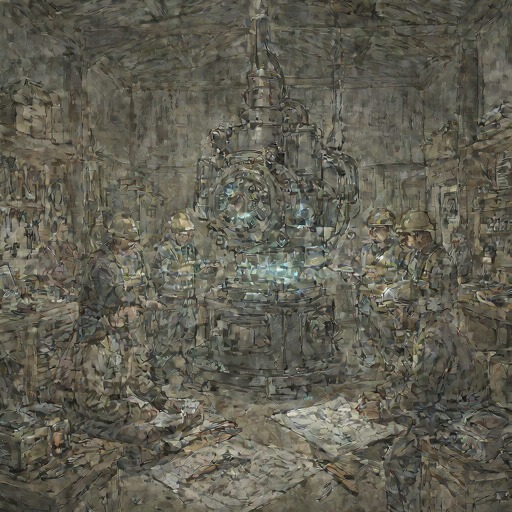
Felix’s research team spends the following year reproducing the buoy’s mechanisms. The effort becomes an all-consuming obsession for Felix and is described as the most important human project since the development of gravity manipulation. Its urgency is not purely scientific. Danielle Fenton has pressed Felix about the team’s progress, while construction of the president’s armed courier has been halted so that the new technology can be copied. Every passing week increases the pressure to restart the military program, turning the experiment into a race against both physics and government priorities.
The team refuses to ignite the device in a densely populated Washington, D.C. For safety and security, a secondary facility is built in northern Wisconsin, a place chosen precisely because it lies far from the inquisitive eyes of modern civilization. The remote setting also supplies the experiment’s recurring comic contrast: the machinery threatens to tear open the universe, while the surrounding countryside contributes an apparently limitless supply of snow for the reactor’s cooling needs.
The test is visibly unstable. The fusion reactor runs at 140 percent, causing the snow covering it to boil into steam, rise to the ceiling, condense on the rafters, and fall back as rain. Technicians and scientists stand—or hide—as far from the reactor as the walls allow while the hyperspace machine howls. The danger is material rather than abstract: repeated cycles at that power level erode the ablative lining of the plasma-containment chamber, and continued exposure to high-energy particles makes even strong materials brittle. If the team cannot stabilize the process, a loop of one-hundred-million-degree plasma may escape.
The Breakthrough
Felix struggles to keep the geometry of the different emitters synchronized as distortions pull them apart. He calculates in real time, trying to outrun a system that appears almost to resist control. The turning point arrives when he abandons the attempt to force the problem into submission. He stops thinking his way through the distortions and lets the current carry him. The irregularities diminish, then disappear, followed by a power spike so intense that everyone in the room later reports seeing flashes like static in the eyes.
The camera inside the vacuum chamber shows the result: a perfect hole that reflects no light. The image confirms that the machine has not merely produced an energetic discharge or a temporary optical illusion. It has opened a passage into hyperspace. The breakthrough is therefore both conceptual and physical: Felix’s team has translated the buoy’s alien operating principle into a stable human-made phenomenon.
The event’s scientific seriousness is repeatedly undercut by the narration’s comic perspective. The reactor’s extreme output, the frightened personnel, and the possibility of a catastrophic containment failure coexist with Felix’s ecstatic reaction and the mundane question of whether anything has happened to Wisconsin. That tonal collision keeps the discovery from becoming a conventional solemn milestone. The universe has been punctured, but the immediate test criterion remains reassuringly local: the facility and its surroundings survive.
Results and Immediate Consequences
Felix reports the experiment as a mixture of good news and bad news. The good news is precise: the team has created and maintained a stable hyperspace window half a meter across for almost thirty seconds. The result is met by cheers and the popping of bottle corks, confirming that the team understands the moment as a genuine success rather than a merely promising malfunction. The bad news is that Wisconsin remains undamaged, a deliberately anticlimactic observation that converts the absence of disaster into the punch line of the experiment.
The window’s size and duration also define the breakthrough’s limits. A half-meter opening maintained for nearly thirty seconds is stable enough to prove the principle, but it is not yet equivalent to a mature transportation network. The test establishes controllability without demonstrating that people, ships, or substantial cargo can immediately pass through it. Its historical importance therefore lies in opening a path for further development, not in completing hyperspace travel in a single experiment.
The event also changes the meaning of the earlier buoy investigation. The object that once appeared motionless, impossible, and beyond established theory becomes the source of a reproducible technology. The mystery has not been dissolved into ordinary physics; instead, human science has been forced to enlarge its working reality. The experiment is a paradigm shift in which anomalies that first seemed like errors become evidence of a new operational framework.
Strategic and Narrative Significance
The stable window immediately carries military implications because the president’s armed courier has been suspended pending the technology’s duplication. A discovery born from exploration can therefore be absorbed into state power before its scientific and ethical consequences are understood. The experiment’s remote location protects civilians from the first test, but it does not protect the invention from militarization or from the institutional pressure that helped drive it into existence.
The breakthrough also foreshadows the book’s later disasters. Hyperspace is not simply a shortcut or a neutral scientific medium. It can produce effects on a planetary scale: D’armic encounters a titanic fire worm in high-space whose mass corresponds to what vanished from Culpus-Alam, while the Lividite military once used a high-space portal to bore through a world and trigger a planetary apocalypse. Later, a red-hot inverted cone appears beyond Earth’s horizon, and a 32.4-terawatt particle beam destroys Xecoron. These events give the Wisconsin experiment a retrospective double edge. Its successful stability is a triumph, but it is also the first controlled step toward forces capable of geocide and retaliation against Earth.
The event’s position in the narrative is consequently ironic. The team celebrates that its experiment has not damaged Wisconsin even as the technology prepares humanity for conflicts in which planets, fleets, and civilizations can be placed at risk. The joke marks a temporary boundary around the disaster; it does not remove the danger. Humanity’s first stable hyperspace window is the moment when the impossible becomes usable, and therefore the moment when human responsibility becomes proportionally larger than human understanding.